.png)


From Voice to Validated Note: The Magic Behind AI Smart Notes' 99% Accuracy
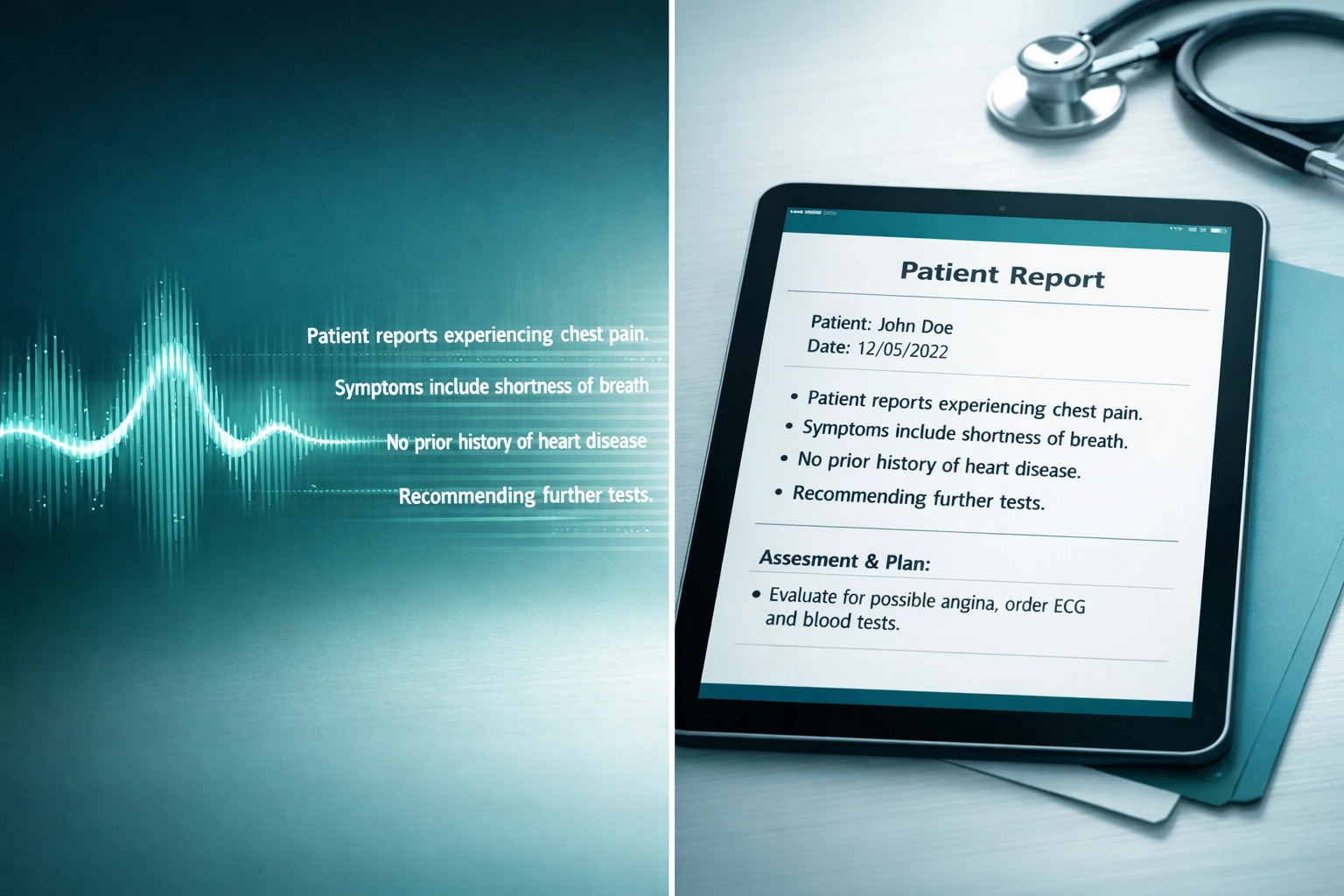
You finish a patient visit. You grab your phone, tap a button, and start talking. Two minutes later, a complete, Medicare-compliant clinical note appears on your screen: formatted, validated, and ready to go.
No typing. No templates. No late-night documentation marathons.
Sound like magic? It's not. It's AI Smart Notes. And that 99% accuracy rate everyone keeps talking about? There's real science behind it.
Let's pull back the curtain and show you exactly how your voice becomes a validated clinical note in seconds.
The Documentation Problem Nobody Talks About
Here's a stat that might hit close to home: clinicians spend an average of two hours on documentation for every hour of patient care. That's not a typo. For every 60 minutes you spend actually helping patients, you're spending 120 minutes writing about it.
And the stakes are high. Miss a required element? Your claim gets denied. Use the wrong terminology? Flagged for audit. Forget a compliance checkbox? Money left on the table.
Traditional documentation is broken. Voice-to-text solutions have existed for years, but most of them just... transcribe. They don't understand context. They don't know Medicare requirements. And they definitely don't catch compliance gaps before you hit submit.
That's where AI Smart Notes changes the game.

Step 1: Capturing Your Voice (The Easy Part)
It all starts when you speak. Whether you're using your smartphone, tablet, or computer, AI Smart Notes captures your natural clinical narrative in real-time.
But here's what makes this different from your phone's basic voice recorder: context-aware speech recognition.
Modern AI transcription systems: like the technology powering our platform: use neural networks trained on hundreds of thousands of hours of audio. We're not talking about generic speech patterns here. We're talking about medical terminology, clinical workflows, and the specific language healthcare professionals use every day.
When you say "patient presents with bilateral lower extremity edema," the system doesn't hear gibberish. It recognizes medical terms, understands their context, and transcribes them accurately: even with background noise, accents, or the occasional interruption.
The result? Transcription accuracy that rivals (and often beats) human scribes.
Step 2: Understanding What You Actually Mean
Raw transcription is just the beginning. The real magic happens in what we call the clinical intelligence layer.
Once your words are captured, our AI doesn't just spit them back out as text. It analyzes the content to understand:
Clinical context: Is this a skilled nursing visit? A physical therapy session? A home health assessment?
Required documentation elements: Based on the visit type, what must be included for Medicare compliance?
Logical structure: How should this information be organized into a proper clinical note format?
Think of it like having a documentation expert sitting beside you, listening to your narrative and organizing it into exactly what payers and regulators want to see.
This is where many voice-to-text tools fall short. They can transcribe, but they can't think. AI Smart Notes does both.
Step 3: Real-Time Validation (Your Compliance Safety Net)
Here's where we separate ourselves from every other documentation tool on the market.
After your voice is transcribed and structured, the note passes through our live validation engine. This isn't a spell-checker. It's a compliance-checker built specifically for healthcare documentation.
The validation engine cross-references your note against:
Medicare billing requirements (including 42 CFR 484 for home health agencies)
Payer-specific documentation standards
Clinical best practices and terminology guidelines
Internal consistency checks (dates, patient information, visit details)
If something's missing or doesn't meet requirements, you'll know immediately. Not after submission. Not when the denial letter arrives. Right now, while you can still fix it.
We've written extensively about why real-time compliance checking eliminates audit stress, but the short version is this: catching errors before they become problems saves time, money, and headaches.
The 99% Accuracy Question: How Do We Get There?
Let's address the elephant in the room. 99% accuracy sounds impressive, but what does it actually mean?
Our accuracy measurement covers three dimensions:
1. Transcription Accuracy This is the foundation: getting your words right. Advanced models like OpenAI's Whisper have achieved word error rates as low as 2.46%, and our system builds on these capabilities while adding medical vocabulary optimization. The result is transcription that captures what you said with near-perfect fidelity.
2. Clinical Accuracy Beyond words, we measure whether the clinical content is correctly interpreted and structured. Does "decreased ROM in right shoulder" end up in the right section? Is the assessment logically connected to the interventions? Our clinical intelligence layer handles this.
3. Compliance Accuracy Finally, we verify that the finished note meets all regulatory requirements. This is where most tools fail: and where our Medicare compliance rates reach 99%.
Combined, these three layers deliver notes that are accurate in every sense that matters.
What About Complex Terminology?
If you've ever used basic voice-to-text and watched it butcher "dyspnea" or "paresthesia," you know the frustration.
AI Smart Notes handles complex medical terminology through specialized training and adaptive learning. The system recognizes:
Anatomical terms and abbreviations
Medication names and dosages
Diagnosis codes and clinical descriptors
Specialty-specific vocabulary (PT, OT, SLP, nursing, and more)
And here's the kicker: it gets smarter over time. The more you use it, the better it understands your specific speech patterns, preferred terminology, and documentation style.
The Real-World Impact
Numbers are great, but let's talk about what this means for your daily life.
Time savings: Clinicians using AI Smart Notes report reducing documentation time by up to 70%. That two-hour-per-one-hour ratio we mentioned earlier? It flips.
Fewer denials: When your notes are validated before submission, claim denials drop dramatically. No more documentation flags holding up your revenue.
Less burnout: Documentation burden is a leading cause of clinician burnout. Taking that weight off your shoulders means more energy for what actually matters: your patients.
Better compliance: With live validation acting as your safety net, you can document confidently knowing every note meets requirements.

See the Magic for Yourself
We could talk about AI accuracy and compliance validation all day. But the best way to understand how voice-to-validated-note actually works? Try it yourself.
CareMetric AI offers a 14-day free trial with full access to AI Smart Notes. No credit card required. No pressure. Just speak, and watch the magic happen.
Ready to transform your documentation workflow?
Because you didn't become a clinician to fight with paperwork. Let AI handle the notes while you focus on the care.
Comments