.png)


7 Mistakes You're Making with Medicare Compliant Documentation (and How AI Clinical Documentation Fixes Them in Real-Time)
Let's be honest, Medicare documentation isn't exactly the highlight of your day. You became a clinician to help patients, not to spend hours wrestling with progress notes and wondering if your documentation will survive an audit.
But here's the thing: documentation errors are costing you more than just time. They're costing you reimbursements, creating compliance headaches, and adding to the administrative burden that's already burning out healthcare professionals at record rates.
The good news? Most Medicare documentation mistakes follow predictable patterns, and modern AI clinical documentation tools can catch and fix them before they become problems. We're talking about real-time validation that helps you maintain 99% Medicare compliance while cutting documentation time by up to 70%.
Let's walk through the seven most common mistakes CMS auditors flag, and how AI-powered solutions are helping clinicians like you save 2-3 hours every single day.
Mistake #1: Insufficient Documentation That Doesn't Support Your Billing
This is the number one reason Medicare denies claims. Your notes are too vague, too brief, or missing key details that prove you actually provided the service you're billing for.
What it looks like:
"Patient doing well, continue current plan"
Missing specific exam findings
No clear link between assessment and treatment
Sparse progress notes that could apply to anyone
How AI fixes it in real-time:
Modern clinical documentation improvement software uses natural language processing to analyze your notes as you create them. If you're billing a Level 4 visit but your documentation only supports a Level 3, the AI flags it immediately, not three months later when the claim gets denied.
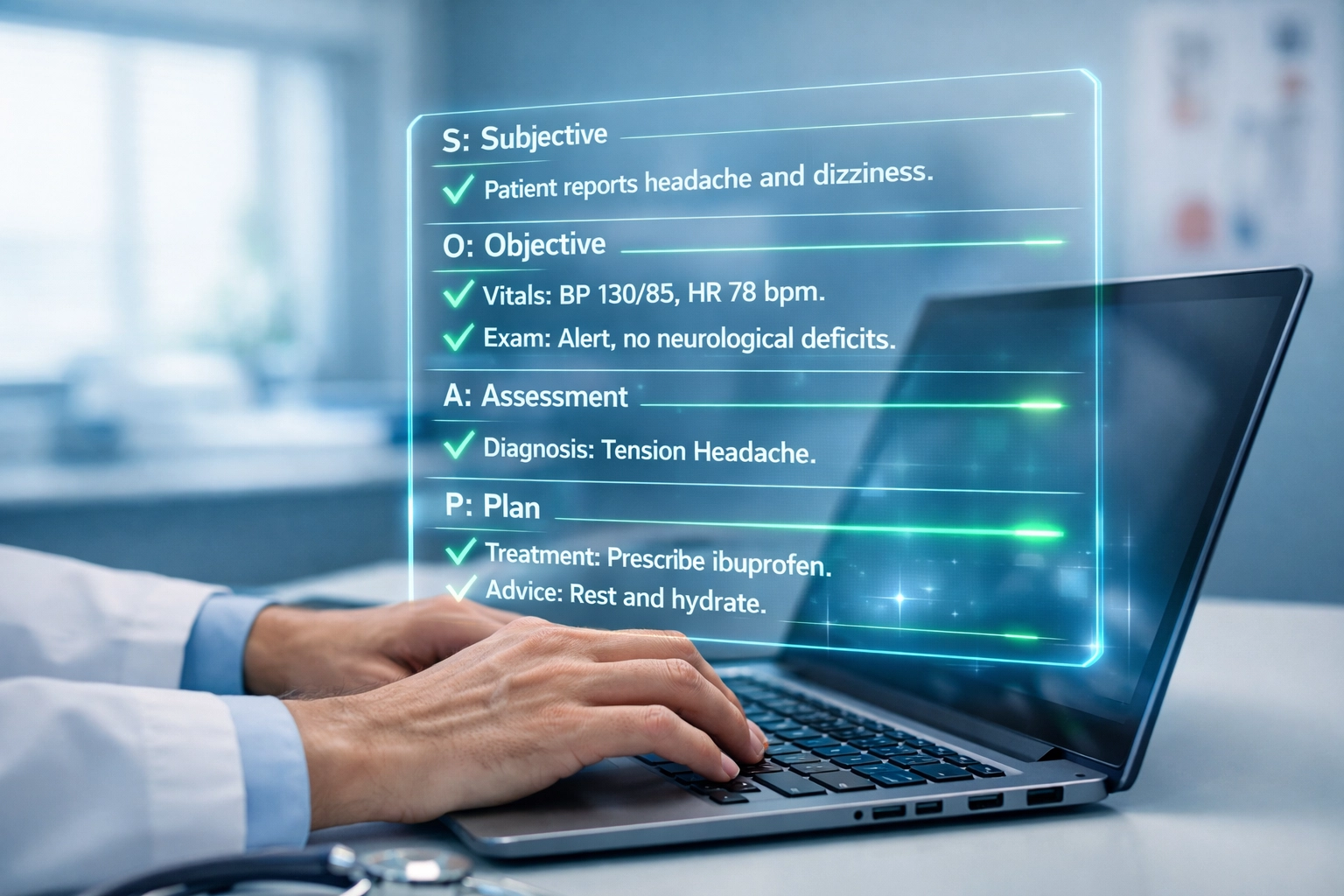
The best AI SOAP note generator tools prompt you for missing elements: "You documented vital signs, but no cardiovascular exam findings were noted for this E/M level." It's like having a compliance expert looking over your shoulder, minus the judgment.
Mistake #2: Missing, Illegible, or Incomplete Signatures
CMS is very clear: if they can't read your signature or verify who provided the service, your claim gets denied. Period.
What it looks like:
Handwritten scribbles that even you can't read later
Missing co-signature from supervising physician
No signature log to clarify illegible signatures
Electronic signatures that don't meet authentication requirements
How AI fixes it in real-time:
Medical dictation software with built-in compliance checking ensures every note includes proper authentication before it's finalized. The system won't let you close a note without a valid signature, and it automatically timestamps and authenticates entries according to Medicare requirements.
For NPs and PAs, AI documentation systems can trigger reminders for required co-signatures based on state regulations and payer policies, no more scrambling to track down your supervising physician days later.
Mistake #3: Failing to Establish Medical Necessity
You know why you ordered that test or treatment. The problem? Your documentation doesn't clearly explain it in a way that satisfies Medicare's coverage requirements.
What it looks like:
Ordering a diagnostic test without documenting the clinical reasoning
Treatment plans that don't clearly link to documented problems
Missing documentation of severity or functional impact
No clear explanation of why this patient needs this service right now
How AI fixes it in real-time:
AI-powered real-time clinical decision support doesn't just help you document, it helps you document smarter. When you order a service, the system prompts: "To establish medical necessity for this diagnostic test, please document: 1) Specific clinical indication, 2) Relevant signs/symptoms, 3) How results will impact treatment plan."
For home health clinicians following 42 CFR 484 documentation requirements, AI tools automatically ensure your notes include the specific elements CMS requires to justify homebound status and skilled need. No more guessing whether you've covered all the bases.
Mistake #4: Coding That Doesn't Match Your Documentation
Your documentation might be excellent: but if you bill it with the wrong code, you've got a problem. This includes unbundling services that should be billed together or upcoding when your notes don't support that level of service.
What it looks like:
Billing a 99214 when your documentation only supports a 99213
Separate billing for services that should be bundled
Using outdated codes or modifiers
Mismatch between diagnosis codes and procedure codes
How AI fixes it in real-time:
AI clinical documentation platforms analyze your note content and suggest the most appropriate codes based on what you actually documented. Think of it as having a coding specialist embedded in your workflow.
The system flags potential issues: "Based on documented history, exam, and MDM complexity, this visit qualifies as 99214. Would you like to add documentation to support 99215, or bill at the 99214 level?" You get to make the final call, but you're making it with full information: before you submit the claim.

Mistake #5: Incomplete Chief Complaint and History of Present Illness
E/M guidelines are specific: you need a documented chief complaint and sufficient history. "Patient complains of pain" doesn't cut it.
What it looks like:
Generic chief complaints without specificity
Missing HPI elements (location, duration, severity, quality, timing, context, modifying factors, associated signs/symptoms)
Inadequate review of systems
No documentation of past, family, or social history when required
How AI fixes it in real-time:
Predictive analytics in healthcare aren't just for identifying at-risk patients: they're also helping clinicians create more complete documentation. AI systems can auto-populate relevant history from previous visits, flag missing HPI elements, and even suggest pertinent questions based on the chief complaint.
For mental health clinicians, specialized AI SOAP note generator tools understand the unique documentation requirements for behavioral health and prompt for elements like mood, affect, thought process, and risk assessment that are essential for Medicare compliant documentation.
Mistake #6: Missing Evidence of Orders or Intent to Order
Medicare wants proof that you actually ordered the services, tests, and treatments you're billing for. "Discussed with patient" isn't enough: you need documented orders.
What it looks like:
No documented order for physical therapy, lab work, or DME
Orders that aren't signed or dated properly
Missing documentation of verbal orders
No clear documentation linking the order to your clinical decision-making
How AI fixes it in real-time:
Home health documentation software with integrated AI ensures every treatment plan includes properly documented orders that meet 42 CFR 484 documentation requirements. The system automatically generates order documentation when you create a care plan, including all required elements like frequency, duration, and clinical justification.
For practices using multiple systems, AI documentation tools can integrate with your EHR to verify that documented services have corresponding orders: catching discrepancies before claims go out the door.

Mistake #7: Not Responding to Documentation Requests During Audits
Sometimes the documentation exists: you just don't submit it when CMS asks for it. Missed deadlines or incomplete submissions result in automatic denials, even when your original documentation was solid.
What it looks like:
Missing audit request notifications buried in mail or email
Incomplete record submissions (you sent some documents but not all)
Documents submitted after the deadline
Disorganized records that don't clearly respond to audit questions
How AI fixes it in real-time:
This is where clinical documentation improvement software really shines with proactive audit preparation. AI systems maintain comprehensive audit trails, organize documentation by encounter, and can generate complete record sets in minutes instead of hours.
Some platforms even predict audit risk based on documentation patterns and automatically flag records that might need additional attention before an audit request arrives. Think of it as audit-proofing your practice on autopilot.
The Bottom Line: Less Rework, More Patient Care
Here's what these seven mistakes have in common: they're all preventable, they all eat up your valuable time with rework and resubmissions, and they're all getting easier to avoid with the right technology.
Clinicians using AI-powered documentation tools report:
2-3 hours saved per day on documentation
70% reduction in time spent on clinical notes
99% Medicare compliance rates with real-time validation
15-25% improvements in quality scores and compliance metrics
That's not just about efficiency: it's about getting back to why you became a healthcare provider in the first place. It's about finishing your day at a reasonable hour. It's about confidence that your documentation will hold up under scrutiny.
The transition to AI-assisted documentation isn't just inevitable: it's already happening. The question is: how much longer will you spend fighting with documentation manually when technology can handle the heavy lifting?
Ready to Fix Your Documentation Workflow?
Stop wondering if your notes will survive an audit. See how CareMetric AI helps clinicians maintain Medicare compliant documentation while saving hours every day with real-time compliance checking, intelligent prompts, and automated quality validation.
Start your 14-day free trial and experience what it's like to finish your documentation with confidence: and actually leave work on time.
Comments