.png)


The Silent Revenue Killer: How Incomplete Notes Cost Your Practice (and How AI Fixes It)
- kdeyarmin
- Jan 30
- 5 min read
Let's talk numbers. The average healthcare practice loses $5 to $8 million annually due to incomplete medical documentation. That's not a typo: and it's not just happening to large hospital systems. Solo practitioners, small clinics, and home health agencies are bleeding revenue every single day because of gaps in their clinical notes.
The worst part? Most providers don't even realize it's happening until the denial letters start piling up.
The Hidden Cost No One's Tracking
Here's what incomplete documentation actually costs your practice:
Immediate financial hits:
Each resubmitted claim costs $25–$50 in administrative overhead
86% of claim denials are preventable with better documentation
Nearly 25% of denied claims are never recovered: that's permanent revenue loss
Long-term damage:
Incomplete notes extend hospital stays by an average of 0.4 days, adding $1,386 per patient in costs
CMS recovery audit denial rates have jumped to 7-10% specifically because of open or incomplete records
Failed audits trigger clawbacks, fines, and potential license reviews

For a mid-sized practice seeing 50 patients daily, even a 5% documentation gap translates to thousands in lost revenue monthly. Multiply that across a year, and you're looking at a substantial hit to your bottom line.
Why Documentation Falls Through the Cracks
It's not that clinicians don't care about documentation: it's that the system makes it nearly impossible to get it right consistently.
Common documentation gaps include:
Missing insurance verification details
Incomplete treatment codes or modifiers
Absent patient demographics or contact information
Vague clinical justifications that don't meet Medicare criteria
Rushed notes that skip required data elements
When you're juggling back-to-back appointments, emergencies, and administrative tasks, something has to give. Unfortunately, that "something" is usually the detailed documentation that keeps the revenue flowing.
The Medicare Compliance Minefield
Medicare documentation standards aren't suggestions: they're requirements. And they're getting stricter.
Medicare compliant documentation must demonstrate:
Medical necessity for every service billed
Clear clinical reasoning and decision-making
Accurate coding that reflects the complexity of care
Complete patient histories and assessment data
Proper authentication and timeliness
Miss even one element, and you're facing denials. String together multiple incomplete notes, and you're inviting an audit.
The challenge is that Medicare compliance isn't just about what you document: it's about how thoroughly you document it. A note that feels complete to a busy clinician might still lack the specific elements Medicare requires for reimbursement.

How AI Changes the Game
This is where artificial intelligence stops being a "nice-to-have" and becomes a business necessity.
Automated quality scoring doesn't just check if your notes are complete: it evaluates them against Medicare's actual documentation requirements in real-time. Think of it as having a compliance expert review every single note before it goes into the system.
Here's what that looks like in practice:
Real-Time Compliance Checking
As you dictate or type, AI analyzes your note against hundreds of compliance criteria. Missing a required element for the diagnosis code you selected? You'll know immediately: not six months later when the claim gets denied.
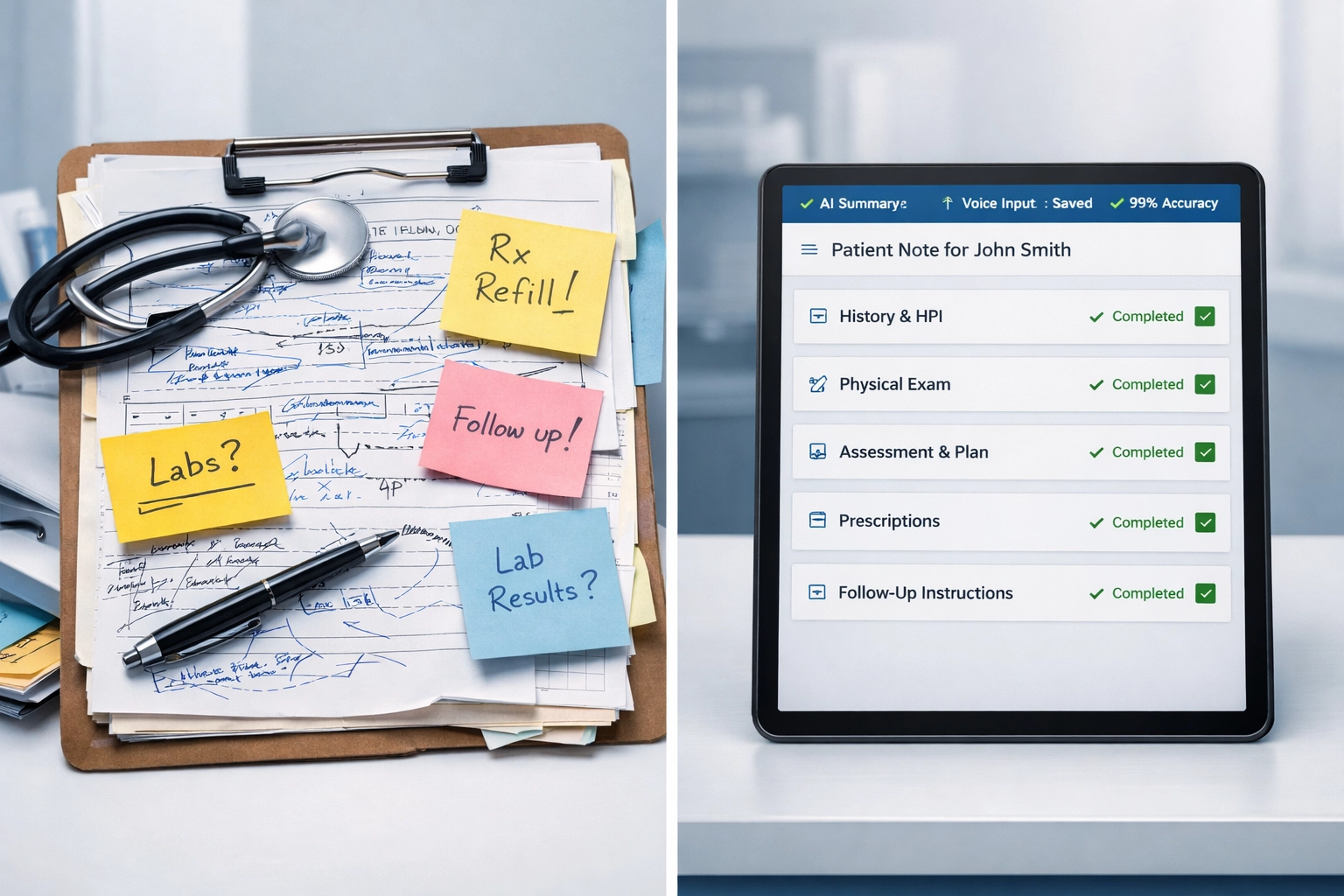
CareMetric AI's automated quality scoring achieves 99% Medicare compliance across thousands of clinical notes. That's not marketing speak: that's the documented outcome when every note gets analyzed against the same rigorous standards every single time.
Intelligent Gap Detection
The AI doesn't just flag problems: it tells you exactly what's missing and why it matters for reimbursement.
"This visit needs additional justification for the level of complexity billed."
"Medicare requires functional assessment data for this diagnosis: add ADL scores."
"This medication change needs documented clinical reasoning."
These aren't generic warnings. They're specific, actionable guidance based on the actual content of your note and the services you're billing.
Automated Quality Improvement
Here's where it gets really interesting: practices using AI documentation see 15-25% improvement in quality scores within the first 90 days.
That improvement isn't because clinicians suddenly became better at documentation: it's because the AI is actively teaching them what complete, compliant documentation looks like. Every correction is a learning opportunity. Every suggestion makes the next note better.
Over time, clinicians internalize these standards. The AI becomes less about fixing problems and more about confirmation that everything's documented correctly.
The Revenue Recovery Timeline
Let's walk through what this means for your practice financials:
Month 1-3: Immediate denial reduction
Fewer incomplete notes means fewer initial denials
Claims go through on first submission
Cash flow improves as AR days drop
Month 4-6: Quality score improvements
More thorough documentation supports higher-complexity billing when appropriate
Audit risk decreases as compliance rates rise
Staff spends less time on claim follow-up and resubmission
Month 7-12: Compounding benefits
Clinicians are more efficient at documentation
Patient throughput increases as charting time drops
Revenue stabilizes at new, higher baseline
For a practice that was losing $100,000 annually to incomplete documentation, that's real money back in the bank: money that can fund better equipment, competitive salaries, or expansion.

Beyond Just Preventing Denials
While avoiding claim denials is the obvious benefit, complete documentation delivers value in less obvious ways:
Better patient care: When notes are thorough, care transitions are smoother. Every provider who touches the patient has complete context.
Reduced legal exposure: Complete documentation is your best defense in malpractice situations. Gaps in records create liability.
Faster audits: When an audit does happen, complete records mean faster resolution and minimal disruption to operations.
Staff satisfaction: Nobody likes resubmitting denied claims or hunting down missing information. Better documentation means less frustrating busywork.
The Implementation Reality Check
You might be thinking: "This sounds great, but implementation is always a nightmare."
Fair concern. But modern AI documentation tools aren't like traditional EMR rollouts.
Typical implementation timeline:
Week 1: Integration with existing EMR (most connect in hours, not weeks)
Week 2-3: Staff training on voice dictation and AI features
Week 4+: Full operation with ongoing optimization
The key difference is that AI documentation adds to your existing workflow rather than replacing it. Clinicians can start using it alongside their current methods, gradually shifting more as they see the benefits.
Start Recovering Lost Revenue Today
Every day your practice operates without automated quality scoring is another day of preventable revenue loss.
The math is straightforward: incomplete documentation costs practices thousands monthly. AI that achieves 99% Medicare compliance and drives 15-25% quality score improvements pays for itself many times over: usually within the first quarter.
Ready to see what complete, compliant documentation looks like in your practice? Start your 14-day free trial and discover how much revenue has been slipping through the documentation gaps.
No credit card required. No complicated setup. Just real-time compliance checking and automated quality scoring that turns incomplete notes into complete, billable documentation.
Your practice can't afford to keep bleeding revenue. Let's plug the leak.
Comments