.png)


Stop Resubmitting Notes: How AI Clinical Documentation Gets You to 99% Medicare Compliance the First Time
- kdeyarmin
- Feb 19
- 6 min read
Let's be real: nothing kills your workflow quite like getting a note kicked back for compliance issues. You've already seen the patient, written your documentation, and moved on to the next 12 things on your to-do list. Then boom: someone from billing is at your door with a rejected claim because you missed a specific detail Medicare wanted or your face-to-face documentation wasn't quite right.
Sound familiar? If you're nodding your head right now, you're definitely not alone.
The worst part? Most of these rejections aren't because you provided bad care or documented incorrectly. They're because Medicare's 42 CFR 484 documentation requirements are ridiculously specific, and it's almost impossible to remember every single checkbox while you're actually trying to, you know, take care of patients.
But here's the good news: AI clinical documentation is changing the game entirely. We're talking about getting to 99% Medicare compliance on the first submission: no more rework, no more late nights fixing notes, no more frustration.
The Real Cost of Resubmissions (It's Not Just Your Time)
Before we dive into the solution, let's talk about what resubmissions are actually costing you and your practice.
First, there's the obvious time drain. When you have to go back and fix documentation, you're not just spending 5 minutes. You need to pull up the patient chart, remember the visit, figure out what's missing, add the required information, and resubmit. That's easily 20-30 minutes per rejected note, and if you're getting multiple rejections a week? We're talking hours of your life you'll never get back.

Then there's the payment delay. Every day a claim sits in rejection limbo is another day your practice isn't getting paid for work you already did. For home health agencies especially, cash flow can get tight fast when reimbursements are delayed by weeks or even months.
And let's not forget the stress factor. Having someone constantly chase you down to fix documentation is exhausting. It interrupts your flow, makes you feel like you're doing something wrong (even when you're not), and adds to the burnout so many of us are already feeling.
Why Traditional Documentation Keeps Getting Rejected
The fundamental problem with traditional medical dictation software or manual charting is that they don't know what Medicare is looking for until after you've submitted the claim.
You write your note based on what you learned in training and what your template includes. Maybe someone in your office gave you tips on what to document. But Medicare requirements change, vary by patient type, and include incredibly specific details that are easy to miss when you're focused on patient care.
Common rejection reasons include:
Missing face-to-face encounter documentation
Insufficient evidence of medical necessity
Copy-paste errors showing resolved conditions as active
Missing required certifications or recertifications
Lack of specific clinical indicators to support diagnoses
Homebound status not adequately documented
The thing is, you probably do have all this information: it's just not documented in the exact way Medicare needs to see it.
How Real-Time Clinical Decision Support Changes Everything
Here's where clinical documentation improvement software with AI makes all the difference: it validates your documentation while you're creating it, not after submission.
Think of it like having a compliance expert sitting next to you during every patient encounter, gently reminding you what needs to be included. Except this "expert" never gets tired, never misses anything, and doesn't judge you for forgetting something.
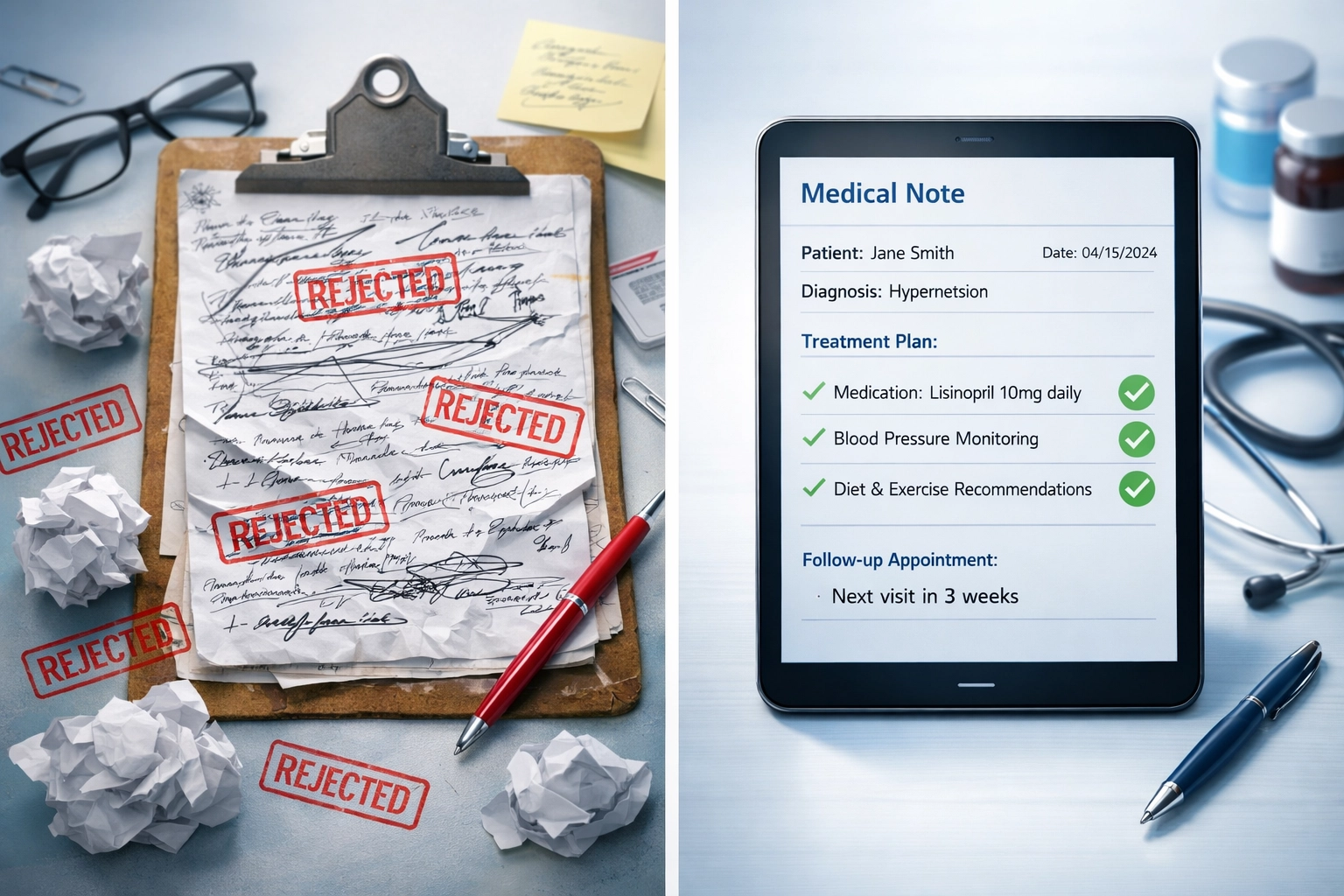
When you're using an AI SOAP note generator with built-in compliance checking, the system analyzes your documentation in real-time against current Medicare compliant documentation standards. It's not just spell-checking your notes: it's actually understanding the clinical content and cross-referencing it with requirements.
For example, if you're documenting a home health visit and you mention the patient's mobility limitations but don't explicitly address homebound status, the AI flags it immediately. Before you finish the note, you can add those few sentences that make the difference between acceptance and rejection.
Research shows that AI-assisted documentation review catches approximately 32% more clinical validation issues compared to traditional review processes. That's a huge jump in accuracy: and it happens before submission, not after.
The Numbers That Matter: Time Saved and Compliance Gained
Let's get specific about what predictive analytics in healthcare documentation actually delivers.
Clinicians using AI-powered home health documentation software are seeing:
2-3 hours saved per day that previously went to documentation and rework
70% reduction in total documentation time compared to manual charting
99% first-time submission acceptance rate for Medicare claims
15-25% improvement in overall quality and compliance metrics
That 70% time reduction isn't just about faster typing. It's about not having to go back and fix things later, not having to hunt through your memory or the patient's chart for specific details, and not having to translate your clinical thinking into "Medicare speak."
Organizations implementing comprehensive AI-assisted documentation have reported denial reductions of 12-18% for complex cases and 20-25% for prior authorization submissions. When your documentation consistently meets requirements right out of the gate, automated adjudication rates increase by 15-30%, which means faster payments and less administrative hassle.

What Live Validation Actually Looks Like in Practice
So what does this look like during an actual patient visit?
Let's say you're a nurse practitioner doing a home health recertification visit. You're using an AI documentation system that provides real-time clinical decision support. As you document:
The AI tracks required elements for that specific visit type (recertification in this case)
It validates clinical indicators against the diagnoses you're documenting
It flags missing information like specific functional limitations or homebound justification
It checks for logical consistency (no copying forward conditions that have resolved)
It ensures face-to-face documentation includes all required components
All of this happens while you're still with the patient or immediately after, when everything is fresh in your mind. No more getting a message three days later that you need to add something you can barely remember.
The best part? The AI learns your documentation patterns and gets smarter over time. It understands your style, your patient population, and the specific requirements you need to meet most often.
Beyond Compliance: Better Patient Care Documentation
Here's something interesting: when you stop worrying about compliance checkboxes and resubmissions, you actually write better clinical notes.
Instead of racing through documentation just to get it done, you can focus on capturing the clinical story that matters. The AI handles the compliance requirements, so you can concentrate on documenting what's actually happening with your patient's care.
This leads to better continuity of care, clearer communication with other providers, and documentation that's actually useful if you need to reference it later: not just a compliance exercise.
Many clinicians report that AI documentation systems help them identify potential issues with patient care plans earlier because the structured documentation process prompts them to consider factors they might otherwise overlook.
Making the Switch: Easier Than You Think
If you're reading this thinking "this sounds great, but changing documentation systems sounds like a nightmare," I get it. Change is hard, especially when it involves your daily workflow.
But here's the reality: continuing to fight with your current system and spend hours on resubmissions is harder. Most modern AI clinical documentation platforms are designed to integrate with your existing EHR and require minimal training. We're talking days to get comfortable, not months.
The ROI is immediate. From day one, you're spending less time on documentation. Within the first week, you'll notice fewer rejected notes. Within a month, you'll wonder how you ever managed without it.
Your Next Step: See It In Action
Reading about AI documentation is one thing. Seeing how it actually works with your workflow is another.
That's why we offer a 14 day free trial at CareMetric AI. No credit card required, no pressure: just a chance to see if this actually delivers the time savings and compliance improvements we're talking about.
During your trial, you'll get:
Full access to our AI SOAP note generator
Real-time Medicare compliance validation
Integration with your current workflow
Support from our team to answer any questions
Ready to stop resubmitting notes and reclaim those 2-3 hours a day? Start your free trial today and see what 99% first-time compliance actually feels like.
Because you didn't become a clinician to fight with documentation. You became one to take care of patients: and that's exactly what you should be spending your time doing.
Comments