.png)


Restoring the "Human" in Healthcare: How AI Documentation Puts Patients First
- kdeyarmin
- Jan 30
- 5 min read
Remember the last time you visited your doctor and they actually looked at you? Not over the computer screen. Not while typing. But really looked at you: listened to your concerns, made eye contact, and gave you their full, undivided attention.
If that memory feels rare or distant, you're not alone. And it's not your doctor's fault.
The Screen That Came Between Us
Healthcare didn't set out to create a barrier between patients and clinicians. But somewhere along the way, documentation requirements grew so complex and time-consuming that the computer screen became the third party in every exam room conversation.

Clinicians aren't ignoring patients because they want to: they're caught in an impossible balancing act. Every symptom, every assessment, every plan must be documented thoroughly for compliance, billing, and legal protection. The result? Doctors spend an average of two hours on documentation for every hour of patient care. That's two hours of typing, clicking, and screen-staring that could have been spent connecting with the people they went into medicine to help.
Patients feel it too. They sit across from their provider, sharing their fears and health concerns, only to watch their doctor's eyes fixed on a monitor. It doesn't feel like healing. It feels transactional.
But here's the good news: AI documentation technology is bringing the human connection back to healthcare.
How AI Removes the Barrier
Ambient AI documentation tools like CareMetric AI work differently than traditional EHR systems. Instead of demanding a clinician's attention, they work quietly in the background: capturing the natural conversation between patient and provider, understanding the clinical context, and automatically generating comprehensive SOAP notes.
Think of it as having an invisible medical scribe in the room who never interrupts, never needs clarification, and handles all the paperwork while your clinician focuses entirely on you.
The technology uses advanced speech recognition and natural language processing to listen to the visit, identify clinically relevant information, and organize it into the proper documentation format. The clinician reviews and signs off on the note: but the heavy lifting of transcription and organization happens automatically.
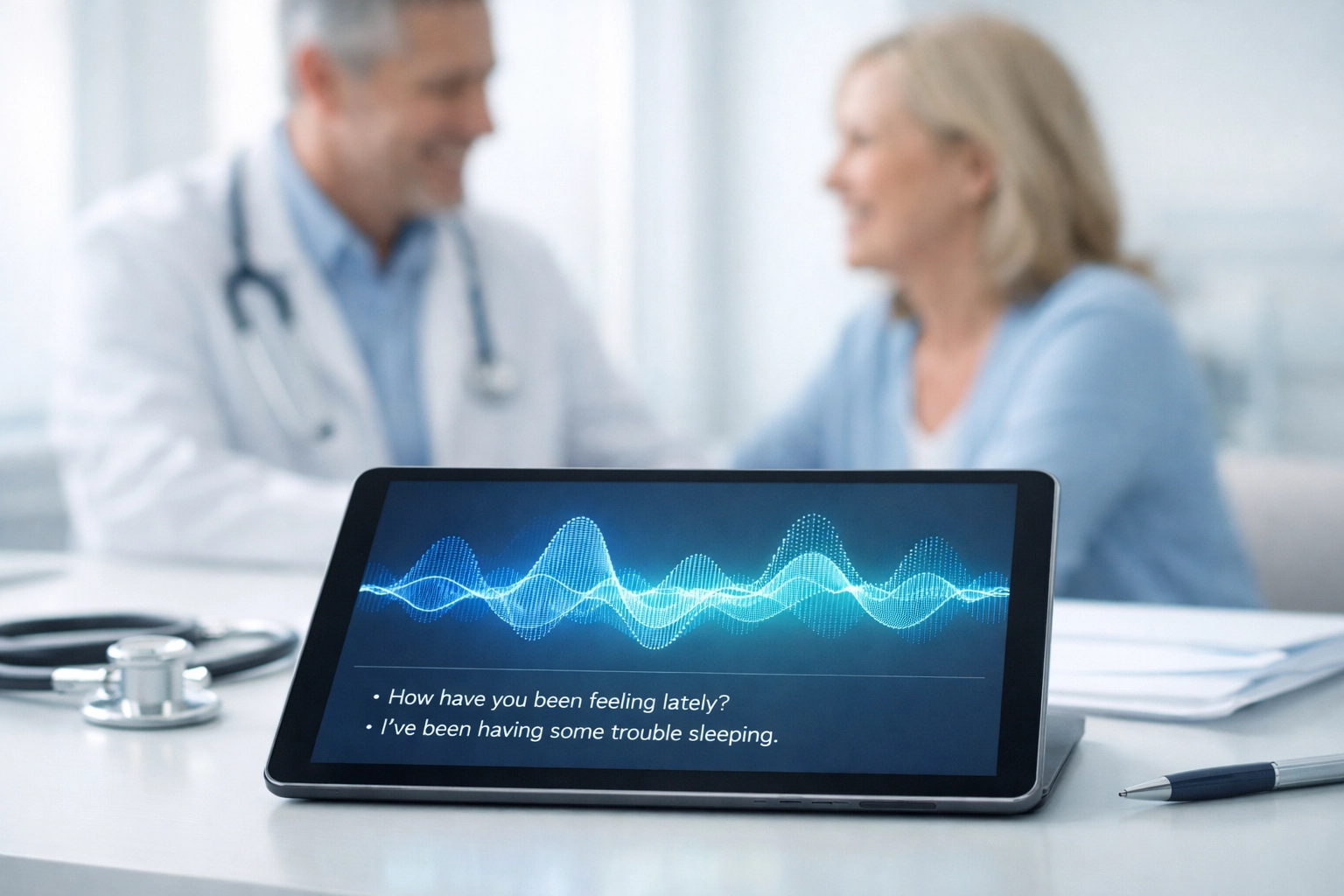
The Permanente Medical Group documented the real-world impact: 2.5 million uses of ambient AI scribes in a single year, saving 15,000 hours of documentation time. Both doctors and patients reported significantly higher satisfaction with the quality of face-to-face interaction during visits.
That's not just a time-saver. That's thousands of meaningful human moments restored.
What Changes When Clinicians Look Up
When clinicians aren't splitting their attention between a patient and a screen, everything about the healthcare experience improves.
Deeper Trust Develops Eye contact isn't just polite: it's powerful. When your provider maintains visual connection throughout your visit, you feel heard. You feel valued. Trust builds naturally when someone gives you their full presence, and trust is the foundation of effective healthcare.
Communication Gets Better Ever tried to have a serious conversation with someone who's typing the whole time? It's frustrating. When clinicians can focus on listening: really listening: they pick up on verbal and non-verbal cues they might otherwise miss. They ask better follow-up questions. They explain treatment options more clearly. The quality of clinical communication improves dramatically.
Nothing Gets Missed Here's the paradox: when clinicians stop trying to document everything manually during the visit, the documentation actually gets more complete. AI captures the entire conversation, organizing information into discrete EHR sections without the risk of human error or forgetfulness that comes with multitasking. Your provider can focus on the clinical conversation, confident that nothing important will be lost.

More Time Feels Available When documentation stress decreases, clinicians can maintain or even expand their patient volume without sacrificing care quality. That means shorter wait times for appointments and more availability for patients who need care. It also means your provider isn't rushing through your visit to make time for paperwork: they can be fully present for the time you have together.
The Patient Experience Transforms
From a patient perspective, AI documentation creates a fundamentally different healthcare experience. You walk into an appointment and your provider greets you warmly: not from behind a computer, but face-to-face. They sit down, they listen, and they engage in actual conversation.
You share your symptoms without watching them frantically type. You ask questions and get thoughtful, unhurried responses. When your provider explains your diagnosis or treatment plan, you can see their face, read their expression, and feel confident they're giving you their expert attention.
It feels less like a transaction and more like care. Because that's exactly what it is.
Patients also benefit from better documentation accuracy. When AI captures the full conversation, there's less risk of important details being forgotten or miscommunicated. Your treatment plan is more comprehensive, your follow-up instructions are clearer, and the continuity of your care improves across providers and visits.
Trust Through Transparency
For AI documentation to truly restore the human element in healthcare, patients need to understand and trust the technology. And that starts with transparency.
Healthcare organizations implementing ambient AI scribes, like UChicago Medicine, describe the technology to patients as "a well-supervised medical scribe working behind the scenes." The AI isn't making clinical decisions: it's supporting your clinician by handling administrative tasks.

Transparency, human oversight, clear communication, and data privacy are crucial for patient trust. When you know that:
Your clinician reviews and approves every note before it's finalized
The AI operates under strict HIPAA-compliant security protocols
The technology exists to enhance: not replace: human expertise
You can ask questions or decline its use if you prefer
...you can feel confident that AI is working for your care, not interfering with it.
This is why CareMetric AI builds transparency into every interaction. Clinicians maintain full control and final approval. Patients receive clear information about how the technology works. And data security remains paramount throughout the process.
The Ripple Effect on Healthcare Culture
When clinicians reclaim time from documentation, something remarkable happens beyond individual patient visits. The entire culture of healthcare begins to shift.
Burnout Decreases Documentation burden is one of the leading causes of clinician burnout. When that pressure lifts, providers rediscover why they chose healthcare in the first place: to help people. Job satisfaction improves. Retention increases. And patients benefit from providers who are energized rather than exhausted.
The Joy Returns Medicine is fundamentally about human connection: the privilege of being present during someone's most vulnerable moments and offering expertise, compassion, and hope. AI documentation removes the obstacles that have been blocking that connection, allowing the inherent joy of healthcare to resurface.
When you see your clinician smile more, listen more attentively, and engage more fully, you're witnessing the restoration of what healthcare was always meant to be.
Putting Patients First, With AI
The promise of AI in healthcare isn't about replacing human clinicians: it's about removing the barriers that prevent them from being fully human with their patients.

Every minute a clinician spends staring at a screen is a minute stolen from patient care. Every documentation task that divides their attention creates distance in the patient-provider relationship. And every administrative burden that weighs on their shoulders diminishes the joy and purpose that drew them to medicine.
AI documentation technology like CareMetric AI doesn't just save time: it restores what matters most. It brings back eye contact, genuine conversation, and the irreplaceable value of human connection in healing.
The future of healthcare isn't about choosing between technology and humanity. It's about using technology to amplify our humanity: to create space for the compassion, expertise, and personal attention that every patient deserves.
Ready to restore the human connection in your practice?Start your 14-day free trial of CareMetric AI and experience what healthcare feels like when technology handles the paperwork and you can focus on what you do best( caring for patients.)
Comments