.png)


How AI Medical Dictation Software Saves Clinicians 2 Hours Daily
Ask any clinician what drains their energy the most, and you'll likely hear one word: documentation. The endless typing, clicking, and data entry that follows every patient interaction has become the silent burden of modern healthcare. But what if you could reclaim two hours of your day: every single day: just by changing how you document?
That's not a hypothetical. It's what AI medical dictation software is delivering right now to thousands of clinicians across the country. And at CareMetric AI, we've built our AI Smart Notes feature specifically to make this a reality for healthcare providers in every specialty.
The Documentation Crisis in Healthcare
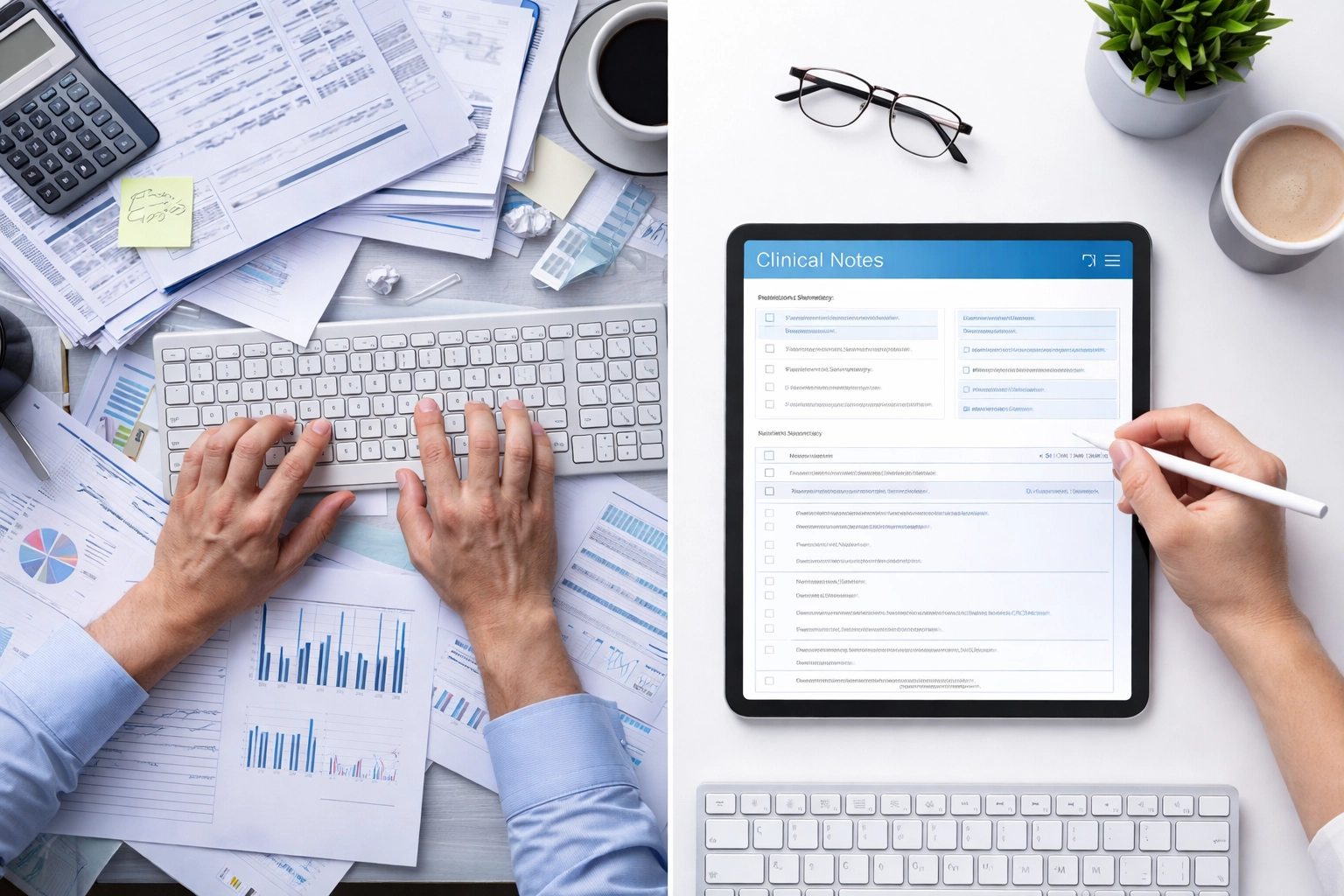
Let's be honest about the numbers. Physicians spend nearly two hours on EHR documentation for every hour of direct patient care. That means if you see patients for six hours, you're looking at another twelve hours buried in charts, notes, and administrative tasks.
This isn't just inefficient: it's unsustainable.
The consequences ripple outward: shorter patient visits, rushed conversations, and the dreaded "pajama time" where clinicians finish their documentation late into the evening. Burnout rates have skyrocketed, with documentation burden cited as a leading contributor to physician dissatisfaction.

Why Traditional Dictation Falls Short
You might be thinking, "I already use dictation software." And you're right: voice-to-text tools have been around for years. But here's the problem: traditional dictation software treats every word the same. It doesn't understand context, can't differentiate between "hypertension" and "hypotension" based on clinical context, and certainly can't format your notes according to your specialty's requirements.
The result? You spend almost as much time editing and correcting transcriptions as you would have spent typing in the first place.
AI-powered medical dictation is fundamentally different. Instead of simple speech recognition, these systems use advanced natural language processing trained specifically on medical terminology, clinical workflows, and documentation patterns.
How CareMetric AI's Smart Notes Transform Documentation
Our AI Smart Notes feature was designed from the ground up to understand medicine the way clinicians actually practice it.
Medical Terminology Accuracy That Actually Works
CareMetric AI achieves 98% accuracy for general medical terms and 95% for specialty-specific terminology. That's not a marketing number: it's the difference between spending 2 minutes on edits versus 20+ minutes with traditional tools.
The system recognizes:
Drug names and dosages in context
Anatomical terms across all specialties
Procedure codes and clinical abbreviations
Specialty-specific jargon and shorthand
When you say "The patient presents with a 3-centimeter Stage IIA melanoma on the left posterior shoulder," Smart Notes captures it correctly the first time: including proper staging notation and anatomical precision.

Voice Dictation That Fits Your Workflow
The beauty of AI-powered dictation is flexibility. CareMetric AI works the way you work:
During the visit: Dictate notes in real-time while examining patients. The AI captures the clinical narrative without disrupting the patient interaction.
Immediately after: Step out of the exam room and complete your documentation in under two minutes while the details are fresh.
On the go: Use mobile dictation between appointments, during rounds, or wherever your clinical day takes you.
This immediacy is crucial. When you complete documentation right after the encounter, you eliminate the backlog that forces clinicians into after-hours work. No more staying late. No more weekend catch-up sessions.
Intelligent Formatting and Structure
Raw transcription is only half the battle. CareMetric AI's Smart Notes automatically structures your dictation into proper clinical documentation format:
SOAP notes for primary care and general practice
Procedure notes for surgical and interventional specialties
Progress notes for inpatient and long-term care settings
Psychiatric evaluations with appropriate mental status formatting
You speak naturally, and the AI handles the formatting. It's that simple.
The Math Behind Two Hours Saved
Let's break down where those two hours actually come from:
Task | Traditional Method | With AI Smart Notes |
Per-patient documentation | 8-12 minutes | 2-3 minutes |
Editing and corrections | 5-7 minutes | 1-2 minutes |
EHR navigation and data entry | 10+ minutes | Automated |
After-hours catch-up | 1-2 hours daily | Eliminated |
For a clinician seeing 20 patients per day, the time savings compound rapidly. Even conservative estimates show 70% reduction in total charting time: which translates to 8+ hours reclaimed every week.
Specialty-Specific Impact
Different specialties experience these benefits in different ways:
Primary Care: High-volume practices see the most dramatic improvements. When you're seeing 25-30 patients daily, shaving 5-7 minutes off each encounter adds up to hours of recovered time.
Cardiology and Neurology: Complex cases require detailed documentation. AI Smart Notes handles the intricate terminology while you focus on clinical reasoning. Clinicians in these specialties report saving 60-90 minutes daily.
Psychiatry: Mental health documentation requires nuanced, detailed notes. CareMetric AI captures the subtleties of psychiatric evaluations while cutting documentation time in half.
Surgery: Operative notes, pre-op assessments, and post-op documentation all benefit from voice-driven workflows. Dictate between cases and maintain your surgical pace.
Seamless EHR Integration
Documentation doesn't exist in a vacuum. CareMetric AI integrates with 50+ electronic health record systems, ensuring that your dictated notes flow directly into the patient chart without manual copy-paste or redundant data entry.
This integration eliminates the friction points that slow clinicians down:
No switching between applications
No reformatting for EHR-specific requirements
No verification steps for data transfer
No duplicate entry of patient information
Your voice becomes the input; the completed chart note becomes the output. Everything in between happens automatically.
Getting Started Is Easier Than You Think
Implementing AI medical dictation doesn't require a complete workflow overhaul. Most clinicians using CareMetric AI report feeling comfortable with the system within their first day of use.
Here's what adoption typically looks like:
Day 1: Basic dictation for straightforward encounters. Focus on getting comfortable speaking your notes rather than typing them.
Week 1: Expand to complex cases and specialty-specific terminology. Notice how the AI adapts to your speaking patterns and vocabulary.
Month 1: Full integration into daily workflow. Documentation happens in real-time, and after-hours charting becomes a thing of the past.
The learning curve is minimal because the technology adapts to you: not the other way around.
The Bigger Picture: Better Care, Better Life
Two hours might sound like a nice efficiency gain. But let's think about what those two hours actually mean.
It's leaving the clinic on time to have dinner with your family. It's mental bandwidth freed up to focus on complex cases instead of administrative tasks. It's the difference between dreading Monday morning and actually looking forward to seeing patients again.
For healthcare organizations, it means reduced burnout, improved retention, and clinicians who can see more patients without sacrificing quality. The ROI extends far beyond time savings: it touches every aspect of clinical practice.
Ready to Reclaim Your Time?
If you're tired of documentation stealing hours from your day, it's time to see what AI-powered medical dictation can do for your practice.
Explore CareMetric AI's features to learn more about AI Smart Notes, or start your free trial to experience the difference firsthand.
Two hours a day. Ten hours a week. Over 500 hours a year.
That's not just efficiency; that's your life back.
Comments