.png)


Beyond the Adjustment: How AI Smart Notes Revolutionize Chiropractic Documentation
You've just wrapped up your last adjustment of the day. Your hands are tired, your patient got the relief they needed, and you actually love what you do. But then you look at your computer screen, eight patient notes still waiting to be written.
Sound familiar?
If you're like most chiropractors, you spend 2-3 hours after patient care documenting everything from subluxation patterns to range-of-motion assessments. You're either staying late at the office or bringing paperwork home, turning what should be a rewarding career into an administrative marathon.
Here's the good news: AI Smart Notes are changing the game for chiropractic practices, and they're doing it in ways that actually understand your specialty.
The Chiropractic Documentation Burden is Real
Let's be honest, chiropractic documentation isn't like other specialties. You're not just noting "patient presented with back pain." You're documenting:
Specific spinal segments (C5-C6 fixation, anyone?)
Palpation findings across multiple vertebrae
Ranges of motion in degrees
Muscle tone assessments
Adjustment techniques used (diversified, drop table, activator)
Post-adjustment evaluations
Exercise prescriptions with precise mechanics
Traditional EHR systems treat you like you're writing a generic medical note. They don't understand the difference between "lumbar lordosis" and "lumbar subluxation complex," and they certainly don't make it easy to document the nuanced work you do.
So you end up typing everything manually, often pulling from templates that still require heavy customization, or worse, dictating into a system that mangles your musculoskeletal terminology.

How AI Smart Notes Actually Understand Chiropractic
Here's where modern AI documentation gets interesting. Unlike generic medical scribes, advanced AI Smart Notes are trained on chiropractic-specific vocabulary and workflows. They can:
Capture Your Natural Language
You can speak naturally during or right after a patient visit: "Patient presents with acute cervicogenic headache, reduced ROM on cervical rotation bilaterally, palpable tenderness at C2-C3, performed diversified adjustment with audible release, tolerated well."
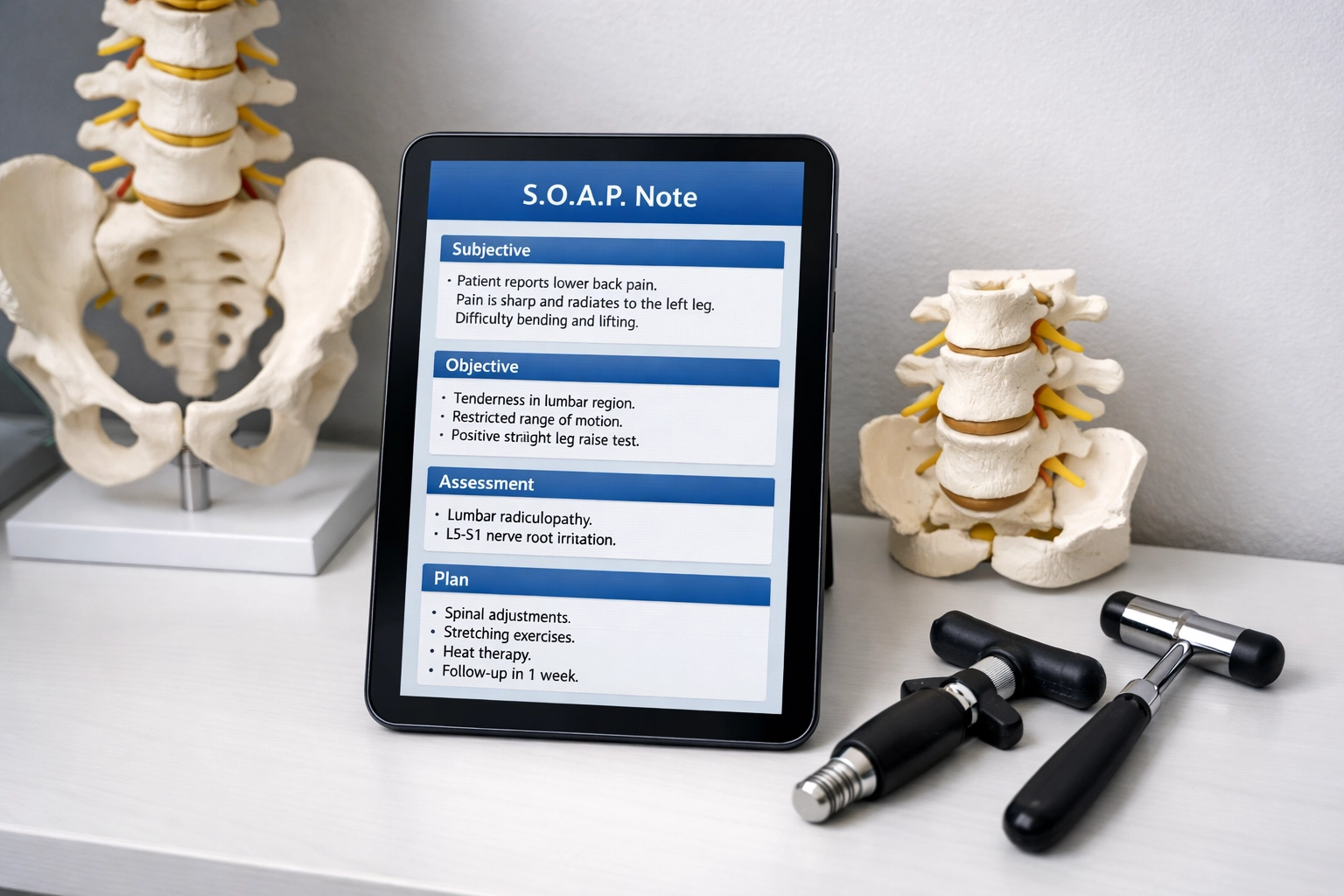
The AI doesn't just transcribe this, it structures it into proper SOAP format, placing each piece of information in the right section.
Distinguish Clinical Content from Casual Conversation
You don't need to dictate in a robotic voice. AI systems are smart enough to know when you're making small talk ("How was your weekend?") versus recording clinical findings ("Marked improvement in thoracic extension since last visit"). Only the relevant clinical information makes it into your note.
Master Musculoskeletal Terminology
This is crucial. AI Smart Notes trained for chiropractic care understand terms like:
Fixation vs. subluxation vs. misalignment
Specific adjustment techniques (SOT, Thompson, Gonstead)
Orthopedic test names (Kemp's, Patrick's, Yeoman's)
Muscle-specific findings (piriformis hypertonicity, levator scapulae tightness)
No more fixing "subscapularis" that got autocorrected to "subscriptions" or explaining to your EHR what a "sacroiliac joint dysfunction" is.
The Time Savings Are Massive (And Measurable)
Let's talk numbers because your time matters.
Traditional note-taking for one patient visit: 7-10 minutes of typing and clicking through templates.
With AI Smart Notes: 30-60 seconds of natural speech, with a review-ready note appearing within seconds.
If you see 25 patients a day, that's the difference between spending 3 hours on documentation versus 20 minutes. Some chiropractic practices report reducing documentation time by up to 92%, that's getting home for dinner instead of documenting until 8 PM.
Real Workflow Integration That Respects Your Process
The best AI Smart Notes don't force you to change how you practice. They adapt to you.
During the Visit
Some chiropractors prefer recording as they go, speaking their observations while examining or immediately after adjusting. The AI captures everything in real-time, building the note as you work.
Between Patients
Others take 30 seconds between appointments to verbally recap what they found and did. This approach keeps your hands free during patient care while ensuring comprehensive documentation.
End of Day Review
If you prefer batching, you can document multiple visits in quick succession, with AI helping you maintain consistency across all notes without sacrificing detail.
The flexibility means you're not locked into a single workflow, you choose what fits your practice style.
Compliance and Coding Precision
Here's something that doesn't get talked about enough: documentation quality directly impacts your revenue and audit risk.
AI Smart Notes help ensure you're capturing the medical necessity justification for every adjustment. They can prompt you for missing elements:
Chief complaint documentation
Objective findings that support your treatment
Functional outcome assessments
Plan of care rationale
This isn't just about checking compliance boxes, it's about protecting your practice from audits and ensuring proper reimbursement. When your documentation clearly shows clinical reasoning and medical necessity, you're far less likely to face claim denials or audit challenges.

What About Accuracy and Verification?
A legitimate question: Can I trust AI with my clinical documentation?
The answer is yes, with the right approach. Modern AI Smart Notes serve as intelligent assistants, not replacements for clinical judgment. You remain in control:
Every generated note is fully editable
You can unsign and modify any content
The AI appends information without overwriting your manual entries
You verify accuracy before finalizing
Think of it as having an incredibly fast, highly accurate documentation assistant who never gets tired, never forgets terminology, and learns your documentation preferences over time.
Beyond Just Note-Taking: Data You Can Actually Use
Here's an unexpected benefit: structured AI documentation creates analyzable data.
When your notes consistently capture specific conditions, adjustment techniques, and outcomes, you can start seeing patterns:
Which techniques work best for specific presentations
Average visit frequencies for different conditions
Outcome trends across your patient population
This turns your documentation from a compliance chore into a continuous improvement tool. You're not just recording what you did: you're building evidence of what works in your practice.
Getting Started Doesn't Mean Overhauling Everything
One of the biggest myths about AI documentation is that it requires a massive technology overhaul or weeks of training.
The reality? Most chiropractors are documenting with AI Smart Notes within their first day. The systems integrate with existing EHRs, work on multiple devices (desktop, tablet, smartphone), and don't require you to change your practice management software.
You can start small: try it with a few patients, get comfortable with the workflow, then expand. There's no requirement to go all-in on day one.
Your Time Matters
Let's bring this back to why you became a chiropractor in the first place.
It wasn't to spend hours typing notes. It wasn't to sacrifice evenings and weekends to administrative work. It was to help people move better, feel better, and live healthier lives through hands-on care.
AI Smart Notes give you that time back. Two to three hours per day: that's 10-15 hours per week, 40-60 hours per month. That's time you could spend with more patients, refining your techniques, being present with your family, or simply not being burned out.
The technology exists. It understands chiropractic terminology. It integrates with your existing systems. And it's ready to transform how you document.
Ready to reclaim your evenings? Start your 14-day free trial and experience what it's like to finish your adjustments and actually be done for the day. No credit card required, no complicated setup: just smarter documentation that works the way you do.
Comments