.png)


Behavioral Health Documentation: Balancing Detail with Efficiency Using AI
- kdeyarmin
- Jan 30
- 5 min read
If you're a mental health practitioner, you know the drill: A meaningful 50-minute therapy session is followed by 20-30 minutes of documentation. You're crafting detailed narrative notes that capture the nuance of your client's presentation, track therapeutic interventions, and meet compliance requirements: all while your next appointment is already waiting.
The documentation burden in behavioral health is uniquely challenging. Unlike other medical specialties where notes can follow more standardized templates, mental health documentation requires rich narrative detail. You're documenting affect, thought processes, behavioral observations, and therapeutic dialogues that can't be reduced to simple checkboxes.
But here's the good news: AI-powered clinical documentation tools are finally catching up to the complexity of behavioral health work. And they're doing it without sacrificing the detail that makes your notes clinically valuable.
The Behavioral Health Documentation Dilemma
Mental health practitioners face a documentation challenge that's different from other healthcare providers. Your notes need to tell a story. They need to capture:
Detailed mental status observations
Verbatim client statements that reveal clinical significance
Complex treatment planning rationale
Progress toward therapeutic goals
Risk assessments and safety planning
The subtleties of therapeutic alliance and client engagement
Traditional documentation methods force you into an impossible choice: Either split your attention during sessions (typing while your client is talking) or dedicate significant after-hours time to recreate the session from memory and abbreviated notes.
Research shows that documentation consumes significant clinician time at the expense of patient care, contributing directly to burnout and reduced service quality. When you're mentally exhausted from documentation, it affects the quality of care you can provide in your next session.

Why Standard Templates Don't Work for Behavioral Health
Many EMR systems offer templated documentation designed for medical encounters. These work reasonably well for a straightforward medical visit, but they fall short for behavioral health documentation.
Therapy sessions are inherently narrative. The therapeutic process unfolds through dialogue, and the meaning emerges from context that can't be captured in dropdown menus. A client's tone of voice when discussing their mother, the long pause before answering a question about their marriage, the shift in body language when trauma is approached: these clinical observations require narrative description.
Yet writing comprehensive narrative notes from scratch after each session is exhausting and time-consuming. It's why many practitioners end up with a backlog of incomplete notes or resort to abbreviated documentation that may not fully capture the clinical picture.
How AI Smart Notes Handle Behavioral Health Complexity
Here's where specialized AI clinical documentation tools designed for behavioral health make a real difference. Unlike generic transcription services or medical documentation tools, AI Smart Notes built for mental health understand the unique requirements of narrative behavioral health documentation.
Ambient Documentation That Understands Context
Modern AI ambient documentation technology can record and process therapy sessions while you remain fully present with your client. The AI isn't just transcribing words: it's identifying clinically relevant content, organizing information into documentation categories, and generating structured narrative notes that reflect the session's therapeutic work.
The technology recognizes when you're conducting a mental status exam, exploring treatment goals, processing trauma content, or providing psychoeducation. It can distinguish between casual conversation and clinically significant material that needs to be documented.
Maintaining Clinical Detail While Saving Time
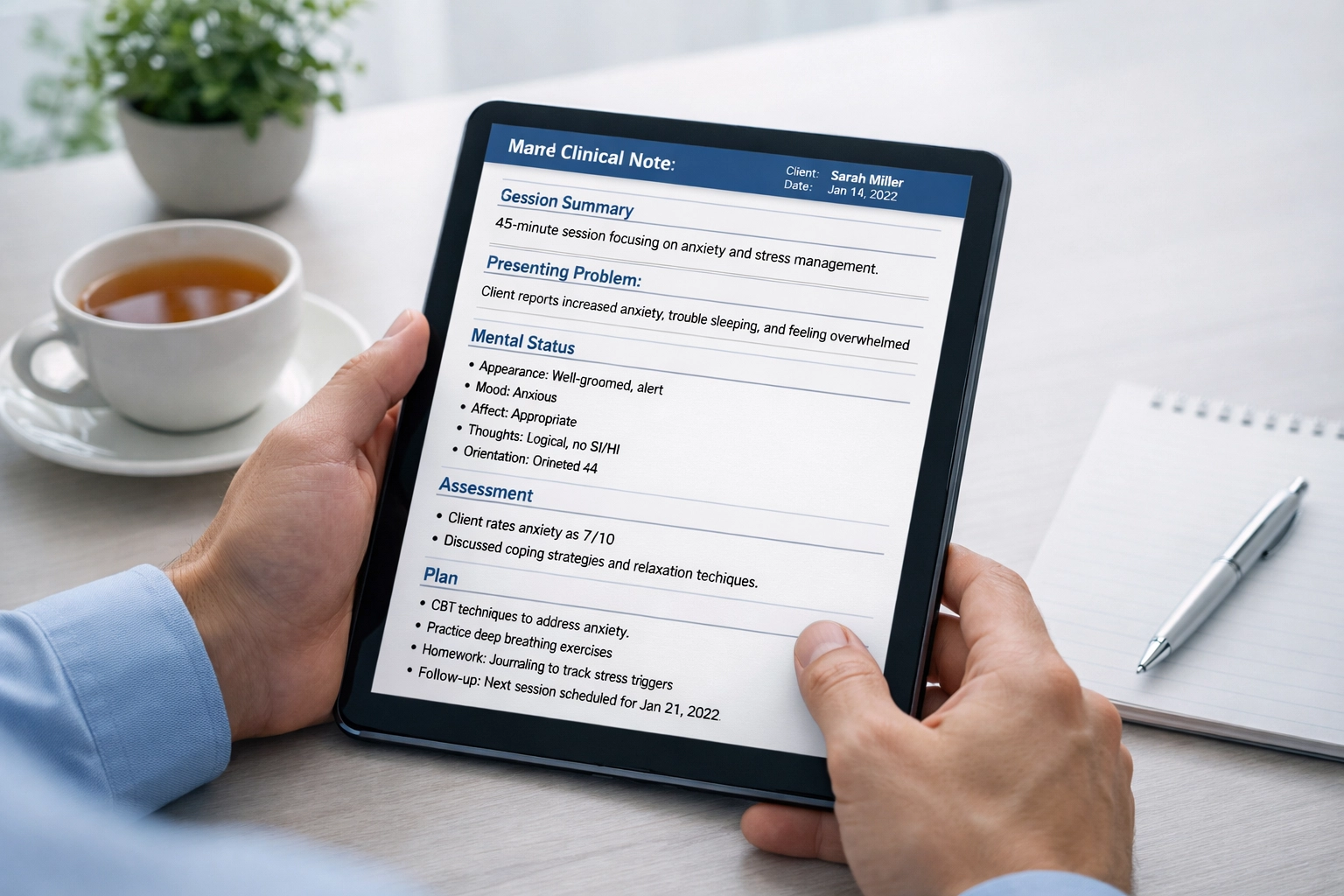
AI systems designed for behavioral health can generate up to 80% of your clinical note by analyzing session data and creating structured narrative entries. The AI drafts sections like:
Presenting problem and current symptoms
Mental status examination findings
Interventions and therapeutic techniques used
Client responses and engagement level
Progress toward treatment goals
Assessment and clinical impressions
Treatment plan adjustments
You retain complete control over the final note. The AI provides a comprehensive draft that captures the session detail, which you then review, edit, and supplement with your clinical judgment. This hybrid approach means you're spending 5-10 minutes refining a detailed draft instead of 20-30 minutes creating a note from scratch.
Real Benefits for Mental Health Practitioners
The impact of AI-assisted documentation in behavioral health settings is measurable and meaningful:
Time Savings That Actually Matter
Studies show documentation time decreased by 30 minutes per day per provider, with some systems reporting 70% reductions in overall documentation time. For a practitioner seeing 6-8 clients daily, that's the difference between leaving the office at 5:00 PM versus 7:00 PM.
Better Session Presence
When you're not mentally tracking what you need to document or splitting your attention to jot down notes, you can be fully present with your clients. Research demonstrates that this increased engagement leads to deeper therapeutic connections and better clinical outcomes. Your clients can feel the difference when you're not distracted by documentation needs.
Improved Documentation Quality
AI-generated notes often include details you might have forgotten or abbreviated in manual documentation. The system captures specific client statements, exact interventions used, and comprehensive mental status observations that strengthen the clinical record. This is particularly valuable for risk assessments, treatment plan justifications, and if your notes are ever reviewed for quality or compliance purposes.
Reduced Burnout
Beyond documentation efficiency, ambient AI systems have shown clinically meaningful reductions in burnout scores among behavioral health providers. When administrative burden decreases, your capacity for compassionate care increases. You have more mental and emotional energy for your clients and your own well-being.
Compliance and Quality Safeguards
A common concern among mental health practitioners is whether AI-generated documentation meets the compliance standards for behavioral health notes. Quality AI clinical documentation tools address this through several mechanisms:
The AI is trained on behavioral health documentation standards and can help ensure your notes include required elements for insurance reimbursement and regulatory compliance. The system can flag when notes might be missing key components like diagnosis justification, medical necessity documentation, or risk assessment details.
However, the clinician always maintains final authority over clinical content. The AI is a documentation assistant, not a replacement for clinical judgment. You review every AI-generated note, add your clinical interpretations, and make any necessary edits before the note becomes part of the official record.
For those interested in how AI handles the technical aspects of voice dictation and complex terminology, this guide on AI Smart Notes and medical terminology provides additional technical details.
Making the Transition to AI-Assisted Documentation
If you're considering AI documentation tools for your behavioral health practice, here's what the transition typically looks like:
Start with lower-risk documentation: perhaps progress notes for established clients where you're comfortable with the format. This allows you to learn how the AI interprets sessions and generates notes without high-stakes pressure.
Review the AI-generated drafts carefully at first. You'll quickly learn the system's strengths and where it needs your input. Most practitioners report that after 5-10 sessions, they develop a workflow rhythm and can efficiently review and finalize AI-drafted notes.
The goal isn't to eliminate your clinical expertise from documentation: it's to eliminate the tedious, time-consuming administrative work so your expertise can be applied more efficiently.
The Future Is Detailed AND Efficient
Behavioral health documentation doesn't have to be a choice between clinical detail and personal time. AI Smart Notes designed specifically for mental health practitioners can capture the narrative complexity your work requires while dramatically reducing the time you spend on documentation.
The technology works because it's designed to support clinician review rather than replace clinical judgment. You remain the expert making clinical decisions and adding therapeutic insights. The AI simply handles the administrative burden of organizing session content into comprehensive, compliant clinical notes.
Ready to experience how AI can transform your behavioral health documentation? Start your 14-day free trial with CareMetric AI and see firsthand how you can maintain detailed narrative notes while reclaiming hours of your week. No credit card required; just better documentation and more time for what matters most: your clients.
Comments